segunda-feira, 17 de outubro de 2011

Irish Language: from Gaeltacht to the dream of bilingualism

The Irish Language is probably the most traditional Celtic language. The oldest records of a Celtic language are Irish – Inscriptions in stone using the Ogham alphabet. The Celtic literary tradition also has its origins in Ireland, first with the comments of Christian monks, later with the compilations of heroic deeds (as the Ulster Cycle) among others.

Ogham alphabet
(Source: Wikipedia)

The Irish (Gaeilge) remained the main language of Ireland for many Centuries, despite the British ruling that started as soon as the Norman invasions. Situation begun to change during the invasions leaded by Oliver Cromwell, when the British forces retook control of Ireland by the most violent ways and established a colonization plan. Cromwell’s Parliamentary government maintained a openly anti-Celt attitude, not only against Irish, but also against Scots, Welsh and inhabitants of Cornwall (cf. Stoyle, 2000 or alternative link). The Irish language progressively lost territory and nowadays is spoken as native language roughly by 60 thousand persons that lives in an area known as Gaeltacht. Only in the Gaeltacht Irish is the everyday life language.


Gaeltacht Area (source: planetware.com)

Is there the possibility of some day the whole Ireland become Gaeltacht again? The Irish Estate has a plan that is just a little less bold than that: to achieve a full bilingual society at the year 2026 (cf. Official Languages Act). Government policies will probably reach some success because the Irish population sees the Irish language as an important part of national identity, even it being spoken just by a few persons. For instance, the editors of this blog found out about the bilingualism goal through an article (Campbell, Bennet & Stephens, 2009 or alternative link) written neither by linguists nor political scientists, but by Marketing Researchers. They were studying the positive impact of brands that chose to use the Irish language.

In a short but very clarifying article McDermott (2011, alternative link) explains the history of Irish language from past to modern times, emphasizing its dissemination policies. For instance, he discourses on what was considered the three central themes of the Language Policy in Ireland since its independence from UK: Pressure, Preferment and Projection. The Pressure comprehends the mandatory study of the language at a basic level in schools. Preferment refers to the condition of first official language of the Irish and how Irish speakers are preferred to occupy some civil servant functions. (To some functions, such as primary teacher, to know Irish language is mandatory). Projection deals with establishing contact between the language and the everyday life of Irish people, translating transit signs, money, administrative buildings signs, etc.

According to the author (Op. cit., p. 3) all these themes affect primarily the public administration, not having a deep impact at individual level. He points out that Gaelic revival depends on two main points: support to its use at a community level rather than by nationwide policies and a focus on urban areas rather than on the current Gaeltacht. As an example to follow, he mentions the Hebrew revival on Israel.

Gaeilge use graphic


 EXTRA MATERIAL

- On Language and Occupational Status (alternative link), Borooah, Dineen & Linch (2009) explain about Preferment and access to public fuctions;
- Yu Ming is Ainm Dom is a movie about a Chinese man who learns Gaeilge in order to get a job at Ireland, but when trying to speak it in Dublin some persons think he is speaking Chinese. It intends to show how the Irish language is something detached from life in the big cities;
-  Teaching and learning Irish in primary school (Harris & Murtagh, 1999, alternative link) collects three studies of Irish taught to young children; one that aims to portrait the current Irish teaching, one about developing tools for the teachers and one about classes of arts and science taught in Irish;
- Retention of Irish skills (Murtagh & Silk, 2004, alternative link) is about retention of Irish language as second language by school leavers and indicates positive results.

domingo, 2 de outubro de 2011

Modern Celtic identity and language

The statement of a Celtic heritage, despite a theoretically objective ethnic trace (the “Celtic blood”), is above all things a subjective ideological act that depends heavily on cultural and political aspects.

If only the ethnic/biological aspect is considered, then, taking in account the Centuries of fractioning and miscegenation through which this people (and all their contemporaries) passed through, we can declare that Celts do not exist anymore. Ethnically, to assume a Celtic identity would make as much sense as to assume an Indo-European one. 

On the other hand, when stated through the preserving of cultural values, the Idea of a Celtic identity detaches itself of a remote past and sticks up to a regional element and to the everyday life: to the practice of old sports (such as hurling, gaelic football and shinty), maintenance of traditional music (mainly bagpipes and gaelic singing) and – the most remarkable trace – the preserving of a Celtic language.

These traces are kept with different intensity in the original Celtic area (see previous topic), but also were transplanted to other places like Canada (Nova Scotia region), United States (that played an active role in the Fenian Movement (cf. Stearns, 1981 or here) and even in the Welsh settlements in Argentine’s Patagonia (cf. Agozzino, 2006).

The statement of a Celtic Identity does not always come along with the uninterrupted maintenance of cultural traces. As it was written in the beginning of this topic, there is also a political aspect in the building of an identity. The remote past may be rescued by a group to establish a sense of otherness in relation to another group. In this type of scenario, the Celtic identity is particularly “productive” by its association (in many periods of History) to resistance against a dominant power. This background was interesting both to the left-wing Irish Republican Army as well as to the right-wing Wise Use movement faction in New Mexico, USA. In an article about this movement (which is against State intervention and is pro-privatism), McCarthy and Hague wrote:

“Those claiming Celtic identity simultaneously maintain a white identity and assert distance from a privileged, dominant position in society” (McCarthy & Hague, 1995, p. 389, [alternative link])

The authors quote in the same article an at least curious speech of the leader of the movement, Jim Catron:

“Alexander the Great and Julius Caesar instantly would have recognized the Marlboro Man as a Kelt, a Gaul” (op. cit., p. 387)

Marlboro Man: a Celt?! (Source University of Texas website)
As we can see, the Celtic identity is something subject to intense debate and, in this debate, the language is a central issue. We point out as an evidence of that the demand that a country/region has of maintaining at least one Celtic language to join the Celtic League and the Celtic Congress. A demand that excludes Galicia, for instance, a region that preserves many traces of Celtic culture, though not the language.

On this blog, we will focus in the preserving and revival of the Celtic languages of the called Six Celtic Nations – Wales, Cornwall, Scotland, Ireland, Isle of Man and Brittany – inside their territories and, eventually, outside them.

The six Celtic Nations

EXTRA MATERIAL
The Irish Speech - On this scene of the TV series Boardwalk Empire, the character Eli Thompson pronounces a speech about the Irish-American support to IRA. It ends up on a fight about Irish identity.

Ancient Celts before Modern Celts

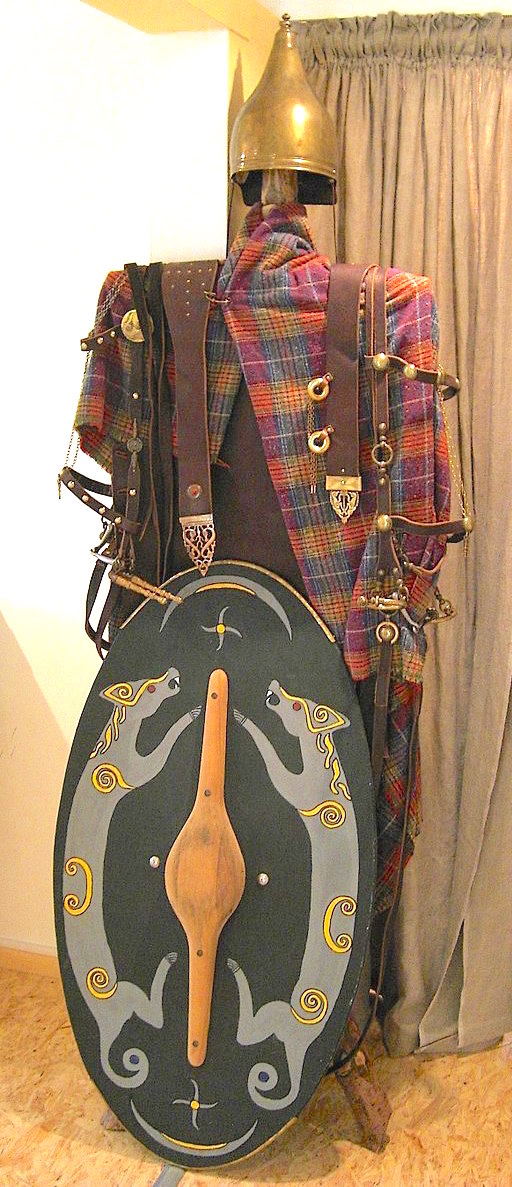
The Ancient Celts occupied areas from Ireland to Turkey. The first records about the Celts were given by Roman historians and place the first contact between these two groups back to 400 BC. This beginning of “relationship” between Celts and Romans is remarkable by the military superiority of the Celts. They took lands from the Etruscans (who were already subordinate to the Romans at that time) and imposed a siege against Rome itself, demanding a ransom of a thousand pounds of gold. After that, though, History started to take a quite different direction. The Celts were conquered and assimilated by the Romans coming from south and by the Germanic tribes coming from the north. That is when a popular Celtic image was built: one of the Celts as a people always in fight against a conquering nation.

This is a flag that the Modern Celts still wave, as we will show next.


Celtic warrior clothes. (Source: Wikimedia Commons).


An introduction

The original Celts were an ethnic group spread through Central Europe and European Islands. Some contemporary communities consider themselves as inheritors of the traditions of that people (the so-called Modern Celts). We intend to aggregate on this blog relevant data of one of these Celtic traditions: the language.